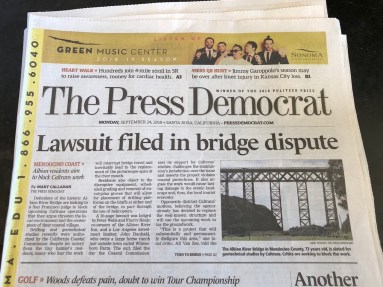
In the news: lawsuit over Albion River Bridge “Geotechnical investigation” development

image1.jpeg

The Santa Rosa Press Democrat ran a front-page article about the lawsuit that has been filed to stop the geotechnical investigation development that Caltrans is planning at the historic Albion River Bridge. An excerpt is below. Here’s the entire article.

Lawsuit filed in bridge dispute

Defenders of the historic Albion River Bridge are looking to a San Francisco judge to block upcoming Caltrans operations that they argue threaten the local environment and the centerpiece of their coastal village.

Drilling and geotechnical studies recently were authorized by the California Coastal Commission despite an outcry from the tiny hamlet’s residents, many who fear the work will interrupt bridge travel and inevitably lead to the replacement of the picturesque span at the river mouth.

Residents also object to the disruptive equipment, scheduled grading and removal of eucalyptus groves that will allow for placement of drilling platforms on the bluffs at either end of the bridge, in part through the use of helicopters.

A 20-page lawsuit was lodged by Peter Wells and Flurry Healy, co-owners of the Albion River Inn, and a Los Angeles investment banker, John Danhakl, who owns a large horse ranch just outside town called Whitesboro Farm. The suit, filed the day the Coastal Commission cast its support for Caltrans’ studies, challenges the commission’s jurisdiction over the issue and asserts the project violates coastal protections. It also argues the work would cause lasting damage to the scenic landscape and, thus, the local tourist economy.

Opponents distrust Caltrans’ motives, believing the agency already has decided to replace the well-known structure and will use the upcoming work to lay the groundwork.

Video of September 20, 2018 Caltrans Public Scoping Meeting: Salmon Creek Bridge Replacement Project

Here’s the video of a Caltrans public scoping meeting held at the Albion School on September 11, 2018 for a proposed replacement of the Salmon Creek Bridge.

(Caltrans held two scoping meetings for this project because members of the local Jewish community expressed concern that the September 11 meeting had been scheduled for the Jewish holiday of Rosh Hashanah.)

“Safe for continued use” and “in remarkably good condition”—Read the Independent Engineers’ Report

Submitted by Albion Bridge Stewards, a working group of ACAB

Two independent professional engineers—world-class experts in timber bridges—have prepared a report on the condition of the Albion River Bridge.

We strongly recommend anyone interested in this bridge download and read their report. To do so, click this link: Albion River Bridge Engineering Report.

Some key highlights:

The bridge is not in need of immediate or near-term replacement. The bridge is in remarkably good condition, thanks to its well-conceived structural design, high-quality timber materials, and effective connection detailing. While there certainly are locations on the bridge that require maintenance and repair, overall the bridge appears structurally sound and safe for continued use, as per the “Safe Load Capacity and Ratings” reflected in Caltrans’ January 5, 2018 Bridge Inspection Report.

The Albion River Bridge is in remarkably good condition, and is not posted with any load capacity/weight limits. The design of the bridge involves a highly redundant structural system with multiple load paths. Features of the design that lead to its robust and resilient character include the following:

  • The timber members are of uniformly high-quality Douglas fir salt-treated by the Wolman method.
  • The timber trusses of the superstructure and support trestles consist of members primarily subjected to axial compression forces, for which heavy timber members are well suited.
  • The dimensional integrity of the bents in the trestles is impressive. Column lines are straight (to the eye) and the bents are planar. (Figure 1 below.)
  • The battered columns provide a base that is wider than the bridge deck, thus enhancing the ability of the bridge to resist lateral loads, such as those from wind.
  • In August 2002, a loaded logging truck plunged down the side of a trestle, destroying the cross-bracing members between bents. The fact that the trestle did not collapse due to the loss of bracing is an indication of the resilient and redundant nature of the trestles and demonstrates how the internal shear connectors might be revealed for inspection (as discussed later in this report) without endangering the structural integrity or safety of the bridge.
  • There is little or no audible rattle below the bridge deck when traffic passes overhead. This observation suggests that connections are tight and members are sound.
  • Generally, access to the connections within the trestles is good, which will enhance the efficiency of inspection, maintenance, and repair activities. Removing bracing members temporarily to inspect the inner connection hardware could be performed relatively easily without requiring closure of the bridge to traffic.
  • Each of the outer-most columns of each bent is heavily bolstered at its base to help distribute compressive load into side-grain bearing on the lower sill plates. The next, inboard line of columns is lightly bolstered, because those columns carry less compression under lateral load. The bolsters appear to be effective in controlling overstress of the sill plates, as we observed no indications of localized crushing due to compression perpendicular to grain.
  • Many of the large timber members have checks – radial cracks on the surface of the timber. The checks tend to be aligned with the longitudinal axes of the members, which suggests that the members have remarkably straight grain, another indication of high- quality material. Checks are not generally regarded as strength-reducing defects and do not require repair. Checks on the sides or bottoms of horizontal members and on any face over vertical or diagonally oriented members are able to drain freely when subjected to rain water.
  • The bridge deck consists of two crossing diagonal layers of timber planks. The upper layer uses tongue and groove planks that lock together and provide uniform support for the asphalt pavement. The lower layer has planks that are spaced to minimize trapping any water that might migrate through the asphalt wearing course and the upper layer. The two layers of planks, properly coupled to the longitudinal stringers along the edges of the deck, have the potential to form an effective diaphragm (a deep, flat beam) to resist out-of-plane loading. With proper drainage detailing, the bridge deck also acts as a roof to protect the superstructure and trestle towers from stormwater runoff.
  • Concrete piers supporting the timber trestles are in good condition. We observed no spalling or cracking. The piers provide uniform bearing support for the sill beams of the trestles.

Action Alert: Email the Coastal Commission Before 5 pm Friday, September 7

Submitted by the Albion Bridge Stewards, a working group of ACAB

At its Wednesday, September 12 meeting in Fort Bragg, the California Coastal Commission will hear comment regarding Caltrans’ proposed geotechnical investigation development—the first destructive step toward tearing down the historic Albion River Bridge. We urge everyone concerned about Caltrans’ expensive, destructive, and unnecessary plans to email the coastal commission before 5 pm on Friday, September 7.

To comment on the plan, visit the Coastal Commission’s agenda page, and locate Item 10a. It’s called “Application No. 1-16-0899 (California Department of Transportation (Caltrans), Mendocino Co.)”.

At the end of the short description, you’ll find a “Submit Comment” link. This will create a new, blank email with the proper address and subject already filled out.

Or, simply send an email to: NorthCoast@coastal.ca.gov

With this subject:
Public Comment on September 2018 Agenda Item Wednesday 10a – Application No. 1-16-0899 (California Department of Transportation (Caltrans), Mendocino Co.)

Not sure what to say? Feel free to use the template below as a starting point. Cut and paste portions of it, or simply put things in your own words—even just a short, “Please deny this unnecessary application and help preserve the Albion River Bridge, not destroy it.”

I urge you to deny the Caltrans application to start on the slippery slope of replacing, for $91 million, the existing sound timber bridge with a wider and straighter concrete one just so the 2,100 cars per day that use it can go faster.

This “geotechnical investigation” development project is a Caltrans work program that is neither needed nor appropriate. As a result of the latest revisions, the project is only in the County’s Local Coastal Program permit jurisdiction, but Caltrans can’t meet the LCP’s standards and wants you to now side-step them.

Caltrans headquarters staff told the Albion community in a public meeting last November that the bridge is “safe” and, contrary to what District 1 staff has represented to you, that it is not “structurally deficient” or “functionally obsolete.” In the same vein, the photographs that Caltrans contributed to your staff report do not show any rigorous analysis of any “exponential decay” of the bridge, but rather splendidly make the community’s and the independent national timber experts recommendation that Caltrans needs to carry out a responsible and publicly transparent bridge maintenance program, with repairs as needed and the seismic retrofit completed.

The project is an exemplar of why we have a Coastal Act to protect this coast, its natural and human-made resources, and the workers in our coastal economy. To summarize the project is to list its blatant direct and cumulative Coastal Act inconsistencies.

The project:

  • Blocks public and worker access on Highway 1 to and along the coast and its many small visitor-serving establishments, to public Albion Cove beach, and to the recreational opportunities on and along the wild-and-scenic Albion River.
  • Preempts the County road for visitor-serving and local boating, lower cost camping, and fishing access at and from Albion Flat, to Albion Cove, the Pacific Ocean, and up the river.
    Removes not only hundreds of trees in the Coastal Commission certified blue heron rookery Environmentally Sensitive Habitat Area at the northwest end of the bridge, but also their entire root system, with foreseeable destruction of the high and fragile bluffs that face Albion Cove and Albion River.
  • Proposes 70- to 125-foot deep drilling into the fractured and unstable earth and rocks on steep to very steep bluff slopes, most of which can only be reached by helicopter. One drilling location is a cultural site of pre-European peoples. and several drill sites are so close to the existing bridge timber towers, the Coastal Act priority visitor serving uses, Highway 1, the beach, and Albion village that Caltrans has to get an impossible approval from the Federal Aviation Administration, since – as you know – its action needs to be consistent with the federally approved Coastal Act and County LCP.
  • The project is clearly inconsistent with many of the mandatory Coastal Act standards, and hasn’t been properly presented to you for geographic jurisdictional reasons. The question, Commissioners, is whether you will uphold the Coastal Act and direct Caltrans to follow the rules, starting with doing an EIR and applying to the County.

Please do the only right thing: deny this coastal permit application. Thank you, for the coast.