A solution for providing pedestrian and bike access across the Albion River

Submitted by Albion Bridge Stewards, a working group of ACAB.

One of the reasons Caltrans offers for replacing the historic Albion River Bridge is that the historic bridge doesn’t provide pedestrian and bicycle access across the Albion River.

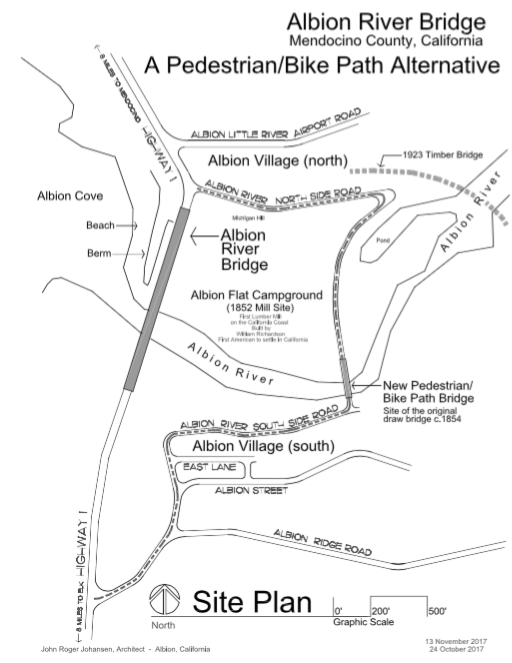
Architect John Johansen has developed a design that addresses this without requiring replacement or alterations to the historic bridge. The solution is a pedestrian bridge over the Albion River, located at the site of the original 1954 drawbridge across the river.

This alternative has some significant advantages:

  • It provides access to Albion village without requiring pedestrians or cyclists to dash across Highway 1. By comparison, Caltrans’ proposed replacement bridge would put foot and bicycle traffic on the west side of Highway 1.
  • It provides a spectacular view of the historic Albion River Bridge and the Albion River.

The footbridge would be built high enough to accommodate marine traffic.

pedestrian_bridge_small

Download a high-resolution PDF of the plan.

Preserving the Albion River Bridge: Questions and Answers

We’ve published a one-page flyer arguing for the preservation of the Albion River Bridge.

Its text is below.

The beautiful Albion River Bridge is the last remaining timber trestle highway bridge on the California coast, and possibly in the United States.

The bridge was built during World War II. Steel, concrete, and redwood were reserved for the war effort, so the bridge was constructed primarily of pressure-treated Douglas fir timber. Concrete was limited to foundations, abutments, and two of the thirteen “bents”—the large towers that make up most of the bridge’s substructure. The portion of the bridge that crosses the Albion River is a steel railroad span that was refurbished in San Francisco.

In 2017, the bridge’s historical significance was recognized on both the state and federal levels: the bridge was placed in the California Register of Historical Resources and in the National Register of Historic Places.

There are economic, environmental, and cultural reasons to preserve this bridge. A new bridge would be extremely expensive and involve signicant disruption to the Albion River watershed, the Albion Flats Campground (one of the few affordable tourist lodgings on the coast), and other local businesses.

What’s more, the tourism industry on our coast is built on a foundation of preservation: of the environment, the historic Mendocino village, the Skunk Train, and the Point Cabrillo Light Station, to name only a few examples. There’s a genuine economic advantage to preserving our historic structures.

We owe it to our history, to our economy, to our environment, to California taxpayers, and to future generations to preserve the Albion River Bridge.

Is the bridge safe?

Absolutely. If the bridge was unsafe, Caltrans would be required to close it immediately.

Isn’t the bridge “functionally obsolete?”

Caltrans often describes the bridge as “functionally obsolete”—which simply means that the bridge doesn’t meet today’s design standards for shoulder width and pedestrian and bicycle lanes.

In reality, there are tens of thousands of functionally obsolete bridges in the country, including the Golden Gate Bridge and most Highway 1 bridges. Yet these bridges are functional and safe, and there is no legal requirement to replace them.

The Bixby Creek Bridge on Highway 1 in Big Sur is also a registered historic landmark. It, too, is “functionally obsolete,” and in the 1990s, Caltrans spent more than $20 million to retro t and preserve the bridge.

Could it withstand a tsunami or earthquake?

Caltrans also describes the Albion River Bridge as being “structurally deficient.” One justification for this is that a “1000-year tsunami” might damage the bridge.

Even in this highly unlikely case, Caltrans states that the bridge would likely survive, and any damage would occur from debris striking the bridge when the waters recede. However, there’s almost no development east of the bridge. Thus, there would be minimal debris in a tsunami out ow—in stark contrast to areas such as Fukashima, Japan.

As for an earthquake, in 2016, Caltrans performed a seismic retrofit to strengthen the steel portion of the bridge, which was the most seismically vulnerable component.

What about toxins in the timbers?

A representative from the California Department of Toxic Substances Control wrote the following in response to a question by a community member: “Arsenic and hexavalent chromium concentrations we have found are higher than what DTSC considers acceptable for a residence. When we estimate risk for a residence, we are assuming a 24 hour, 365 day/year presence. However, since the areas of contamination are not a residence, but rather in a recreational setting, we do not necessarily think there is an issue with current land use.”

What’s more, if the bridge is torn down, its timbers would have to be trucked to a Class 1 hazardous waste facility. e closest such facility is in Kettleman City, 300 miles away—hundreds of truckloads of toxic waste on local and state roads.

Lastly, any discussion of environmental hazards must also take into account the environmental impact of a proposed new bridge: not only the disposal of the historic bridge, but the impact of construction and geotechnical investigations on the Albion River, a federally designated wild and scenic waterway.

Is there room for pedestrians and cyclists?

There are several ways to accommodate pedestrian and bicycle traffic across the Albion River, and they can be added for a fraction of the cost of building a new bridge.

Isn’t the bridge expensive to maintain?

The bridge has annual maintenance costs of about $150,000—a fraction of the cost of building a new bridge, demolishing the historic one, and transporting and disposing of tons of toxic waste.

Add to this the other benefits of preserving a historic structure: the economic benefits to tourism and local businesses, and the intangible but very real benefits to the fabric of a community.

Isn’t it cheaper to just build a new bridge?

No. In 2024, Caltrans estimated a new bridge would cost up to $135 million. It’s easy to imagine a new bridge costing far more, considering that construction wouldn’t begin for several more years, and that cost overruns are common.

Facts and Figures

Opened for traffc: 1944
Designated a state and national historic landmark: 2017
Length: 969 feet
Height above river level: 150 feet
Width: 26 feet
Width of proposed replacement bridge: 47 feet
Original cost: $370,000
Cost of replacement bridge: up to $135 million (Caltrans 2024 estimate)
May 9 Caltrans meeting in Albion to discuss Community Impact Assessment for bridge projects

Submitted by Frank Demling, Caltrans project manager

Caltrans and their environmental consultant, ICF, have reserved the Albion Ridge Elementary School for Tuesday, May 9, 2017 from 6:00 P.M. to 8:00 P.M. to meet with the local community to discuss the Community Impact Assessment (CIA) for the Albion River and Salmon Creek bridge projects.

The CIA is an iterative process that will assist in the planning, project development, and decision making throughout the life of both projects. The CIA will include an analysis of the potential impacts that each project alternative would have on the community and identify opportunities to avoid, minimize, and /or mitigate any adverse effects from each alternative.

Public involvement is an integral part of the CIA process and we hope that as many community members as possible will be able to attend this very important meeting.

Please feel free to submit your questions, comments and concerns, as well as any topics you would care to discuss relative to the CIA process, for the open discussion portion of the meeting.

You may contact Liza Walker, Senior Environmental Planner, at (530) 741-4139, email liza.walker@dot.ca.gov or Frank Demling, Project Manager, (707) 445-6554, frank.demling@dot.ca.gov if you have further questions.

Draft meeting agenda as follows:

  • Project Descriptions
  • Salmon Creek Project Alternatives
  • Albion River Project Alternatives
  • Environmental Documents
  • Salmon Creek Project Initial Study / Environmental Assessment
  • Process and Opportunities for Input
  • Albion River Project Environmental Impact Report / Environmental Assessment
  • Process and Opportunities for Input
  • Review Environmental Resource Categories
  • Community Impact Assessment (CIA)
  • Project Location
  • CIA Study Area
  • General Plan Land Use Designations
  • Zoning
  • Farmland/Timberland
  • Community Resources
  • Request Public Input Regarding Community Resources
  • Open Discussion


April 30 Meeting: Participate in the Environmental Impact Review Process

What’s the next step in the proposed replacement or rehabilitation of the Albion River Bridge? A draft Environmental Impact Report (EIR), which Caltrans will be producing in the months to come.

One part of the EIR process involves the public—that’s all of us—having the opportunity to comment on how this proposed project might affect you or the community.

  • Do you have a business that would be affected by lengthy traffic delays, construction noise, and other disruptions?
  • Do you have a home in the Albion area that might be affected by delays in emergency response vehicles, such as fire trucks and ambulances?
  • Do you use the Albion River for commercial or sport fishing or recreational activities, such as kayaking?

These are just a few of the issues that you have the opportunity to weigh in on—but only until May 7.

ACAB has prepared a detailed document that we will submit to Caltrans prior to the May 7 deadline. Download the PDF hereIf you’re interested in signing your name to this document, please attend our next meeting.

If you’d like to write your own comments to Caltrans, you can do that, too. Send your comments to:

Caltrans
Attn: Adele Pommerenck
Office of Environmental Management
703 B Street
Marysville, CA 95901

You can also email comments to adele.pommerenck@dot.ca.gov.

But if you agree with the comments expressed in the official ACAB document, please attend the meeting and add your signature to the list!

April 14 Scoping Meeting

On Tuesday, April 14, from 6 to 8 pm, Caltrans will hold a scoping meeting at the Albion Elementary School (map).

At this meeting, Caltrans representatives will detail the current status of the planning process regarding the rehabilitation or replacement of the Albion River Bridge, as well as other aspects of the proposed construction project, which includes replacement of the Salmon Creek Bridge as well as widening and straightening of Highway 1 from Navarro Ridge Road to Albion Ridge Road.

This is a significant project, both in terms of cost and potential environmental and traffic impacts. Everyone is encouraged to attend and express their opinions and concerns regarding the project. Caltrans will be accepting written comments at this meeting.

For the Albion River Bridge project, Caltrans has prepared a “Notice of Preparation” document (NOP) that describes the project, its current alternatives, and potential environmental impacts. A PDF of the document is available.

Albion River Bridge in The New York Times

The Albion River Bridge made the front page of The New York Times‘ National news section with a detailed article by Times reporter Carol Pogash.

ALBION, Calif. — Sometimes, a bridge is more than a way to get from here to there.

In this ruggedly beautiful town overlooking the Pacific Ocean, residents want to save the Albion River Bridge because they say it defines them. But state officials say the bridge — the last wooden bridge on California’s coastal highway — is too narrow, is too expensive to maintain and would be too vulnerable in a major earthquake. They want to replace it with an arched concrete structure, but a vocal group of residents objects.

Read the entire article.